A random variable X is said to follow a Normal Distribution with parameters [katex] \mu [/katex] and [katex] \sigma [/katex] if it has a probability density function given by:
f(x;\mu,\sigma) = \frac{1}{\sqrt{2\pi}\sigma} e^{-\frac{1}{2\sigma^2} \left( x - \mu \right)^2} ; -\infty < x<\infty , -\infty < \mu <\infty , \sigma > 0A random variable X is said to follow a Normal Distribution with parameters [katex] \mu [/katex] and [katex] \sigma [/katex] if it has a distribution function given by:
F(x) = \int_{-\infty}^{x} \frac{1}{\sqrt{2\pi}\sigma} e^{-\frac{1}{2\sigma^2} \left( y - \mu \right)^2} dyFirst Four Moments:
 E(X) =   \int_{-\infty}^{\infty} x f(x;\mu,\sigma)dx \\
= \frac{1}{\sqrt{2\pi}} \int_{-\infty}^{\infty} (\mu + \sigma y) e^{-\frac{y^2}{2}}dy \left[ \textit{Putting, } \sigma y = x-\mu  \right] \\
= \mu + 0 \left[ \textit{Since, } ye^{-\frac{y^2}{2}}  \textit{is an odd function} \right] \\
\mu_2 = V(X) = E(X-\mu)^2 =  \int_{-\infty}^{\infty} (x - \mu)^2 f(x;\mu,\sigma)dx \\
= \frac{1}{\sqrt{2\pi}} \int_{-\infty}^{\infty} ( \sigma y)^2 e^{-\frac{y^2}{2}}dy \left[ \textit{Putting, } \sigma y = x-\mu  \right] \\
=  \frac{\sigma^2}{\sqrt{2\pi}} \int_{-\infty}^{\infty} y^2 e^{-\frac{y^2}{2}}dy  \\
=  2 \frac{\sigma^2}{\sqrt{2\pi}} \int_{0}^{\infty} y^2 e^{-\frac{y^2}{2}}dy  \left[ \textit{Since, } y^2e^{-\frac{y^2}{2}}  \textit{is an even function} \right] \\
= \frac{2\sigma^2}{\sqrt{2\pi}}  \int_{0}^{\infty} \sqrt{2 p} e^{-p}dp \left[ \textit{Putting, } 2p = y^2   \right] \\
= \frac{2 \sigma^2}{\sqrt{\pi}} \Gamma(3/2) = \sigma^2 \\
\mu_3 = E(X-\mu)^3 = 0 \\
\mu_4 = E(X-\mu)^4 =  \frac{4 \sigma^4}{\sqrt{\pi}} \Gamma(5/2) = 3 \sigma^4
Skewness and Kurtosis
\gamma_1 = \frac{\mu_3}{\mu_2^{3/2}} = 0 , \\
\gamma_2 = \frac{\mu_4}{\mu_2^2} -3 = 3-3 =0
Some Interesting Properties of Normal Distribution
If a continuous random variable X follows [katex] N(\mu,\sigma) [/katex] , then
- The distribution is symmetric about [katex] \mu [/katex].
- The normal probability curve has point of inflection at [katex] \mu \pm \sigma [/katex].
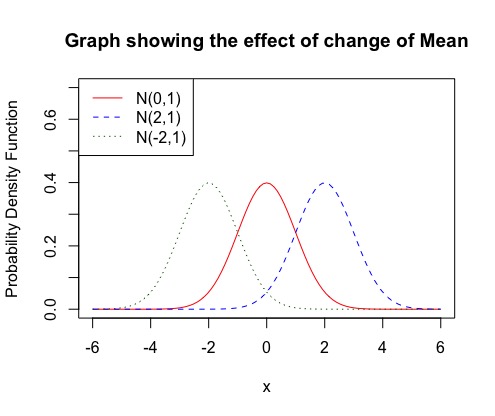
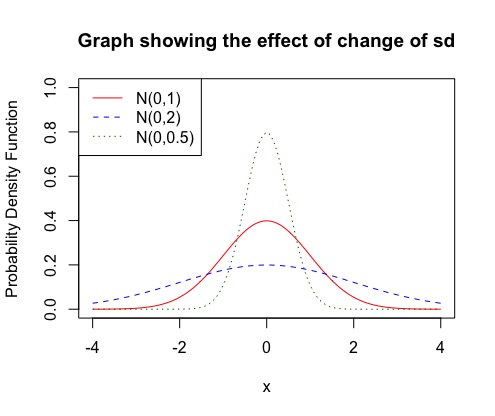
- Owing to the fact that a change in the mean value changes the location of the probability curve of a normal distribution and a change in the variance value changes the shape of the probability curve, [katex] \mu \textit{and } \sigma^2 [/katex] are called the location and scale parameters respectively.
- The distribution is symmetric about [katex] \mu [/katex] and hence the mean, median and mode of the distribution are the same. Also all odd order moments about the mean are zero.
- The mean deviation about mean is [katex] \sqrt{\frac{2}{\pi}} \sigma [/katex]
- A normal distribution with mean 0 and variance 1 is known as standard/unit normal distribution. And the pdf and pdf of the standard normal distribution is usually denoted by [katex] \phi(.) \textit{and} \Phi(.) [/katex] respectively. It satisfies the following relations,
1. \phi(x) = \phi(-x) , \forall x\in \mathbb{R} \quad \\
2. \Phi(x) = 1 - \Phi(x) , \forall  x\in \mathbb{R} \\
3. \Phi(0) = 0.5 \qquad \quad ...........
4. \quad 1-\Phi(x) \\
= \frac{1}{\sqrt{2\pi}}e^{-\frac{x^2}{2}} \left\{ \frac{1}{x} - \frac{1}{x^3} + \frac{1.3}{x^5} - \frac{1.3.5}{x^7} + \dots + (-1)^k \frac{1.3\dots(2k-1)}{x^{2k+1}}\right\} Discovering Statistics
Leave a comment